Journal · Brand
How to Start a Clothing Brand: A Step-by-Step Guide
2026-09-22 · 8 min
Starting a clothing brand is a product decision that later becomes a company. Founders who stall usually reverse that order. They reserve a name, sketch a logo, and announce a drop date before anyone has agreed what the garment weighs, how it fits, or what it costs to make a second time.
You do not need a twenty-style lookbook to begin. You need one product you can describe precisely, a sample you have held, and a manufacturer who can repeat it. The name, the photographs, and the first customers sit on top of that garment.
Start with a customer and one product
Write down who wears it and in what situation. “People who like streetwear” is not a customer. “People who already buy heavyweight hoodies and care more about the shoulder and the fleece than about a large chest logo” is a customer. That sentence tells you the fabric, the fit, and the price band before you talk to a factory.
Pick one style as the first production style. A hoodie, a T-shirt, or a pair of sweatpants is enough. A matching set can wait until the top and the bottom have each been sampled on their own. Six styles in the first week usually produce six average garments. One clear style produces a pattern someone can correct.
If you are unsure which category fits the brand, look at how cut-and-sew programs are actually divided — hoodies, T-shirts, sweatpants, streetwear, and sportswear — and choose the one you can brief this month.
Write the garment down before you ask for a price
A factory cannot quote a feeling. Before you ask for a unit price, write a one-page brief. It does not have to be a formal tech pack on day one. It does have to remove the guesses.
- Product and silhouette, such as a pullover hoodie with a dropped shoulder
- Fiber and construction, such as cotton fleece with a brushed back
- A target weight, even if it is a range rather than a single GSM
- A reference garment you own, with notes on what to keep and what to change
- Decoration, or a clear line that the first sample is blank
- The sizes for the first sample, usually one or two, not a full graded set
- Labels: woven main label, care label, hangtag — or blank until the fit is approved
- The quantity you expect for the first bulk order, stated per color
That page is the same document you will use to request a quote. If the first product is a hoodie, the notes on how to brief a custom hoodie manufacturer show which measurements save a sampling round.
Budget the sample as its own project
The first invoice is not the bulk order. Pattern work, a short length of fabric, trims, courier, and at least one revision all cost money. Founders who spend the whole budget on a future production run have nothing left when the sleeve is wrong.
Ask the factory to separate sampling cost from the bulk unit cost. A cheap sample in substitute fabric teaches the wrong lesson. The sample should be cut from the cloth you intend to sell, or the factory should say in writing that it is a substitute and what will change at bulk.
Private-label manufacturing means the fit, the labels, and the packing belong to your brand. That only holds if the sample was built to your spec, not taken from a stock blank already on a rail. The private-label checklist is the shorter list of what to confirm before a production order.
Name, labels, and the paperwork you cannot skip
You can sample under a working name. You should not weave a name into a main label, or ship a bulk order, until you know you can use it in the countries where you sell. Changing a woven label after it is made is a delay, not a small tweak.
The care label has to match the fabric you actually approved. If the composition changes between sample and bulk, the label changes with it. Origin marking depends on the destination. A factory can print the text you specify. It should not be your only source of legal or customs advice. Ask a forwarder or an advisor what the garment and the carton must say.
Decoration, woven labels, and packaging are specified together. The customization page is where those choices sit beside the fabric: print, embroidery, wash, labels, and packing. Leave artwork off the fit sample if you are still deciding it, and say so, so nobody guesses a placement.
Choose a factory you can go back to
The manufacturer is a production partner for the next season, not a one-time vendor. You will want the same pattern again. Read how to find a clothing manufacturer in China before you pay a deposit to the first supplier that replies.
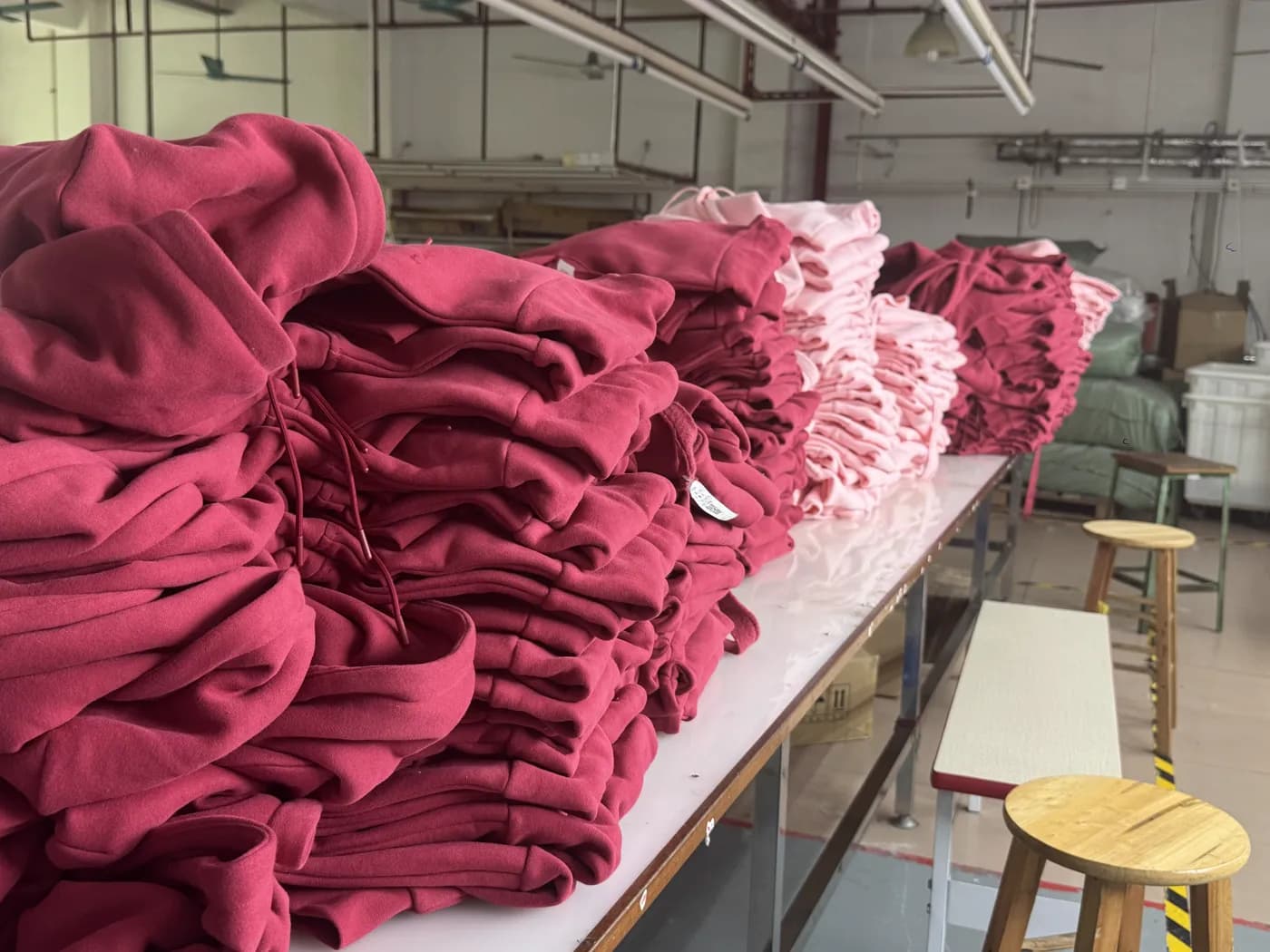
Visit if you can. If you cannot, ask for recent photographs of the sewing floor and the sampling room, and compare them with what the factory already publishes. A factory floor record is more useful than a catalog cover. You are looking for a workshop that cuts and sews, not a trading desk that cannot show you where the garment is made.
An example: a two-color hoodie
A founder wants a heavyweight pullover, sold direct, in black and a heather grey. The brief says cotton fleece, a dropped shoulder, a rib cuff that recovers after wear, no print on the first sample, and a woven label to follow once the fit is approved. The bulk intention is stated per color, because minimums are usually counted that way. Many hoodie programs discuss orders from about 100 pieces per color per style. The factory should confirm the number for that cloth, especially if a wash or a special yarn is involved.
The first sample comes back at the right weight, with a sleeve that twists. The revision note says: keep the body and the fleece, correct the sleeve pitch, and do not change the weight to hide the twist. That note can be sewn. “Make it more premium” cannot.
When the revised sample is approved, the selling price comes from the bulk quote, the labels, the packing, the freight, and room for returns. A launch date goes on the page after that arithmetic, not before it.
A sequence that keeps the launch honest
- Describe the customer and the first style in a few sentences.
- Write the brief: fabric, fit, a reference garment, decoration, and a target bulk quantity per color.
- Shortlist factories and ask for a sampling plan, not only a unit price.
- Approve a fit sample in the intended fabric. Revise once, in writing.
- Lock labels, packing, and a pre-production sample.
- Photograph the approved sample.
- Take the first orders, then cut bulk against the approved spec.
The photographs and the first customers belong in how to market a new clothing brand. They work better after the sample is approved than before it. Fabric choice, which decides how that sample feels in the hand, is covered in how to choose the right fabric.